Concrete Calculator: Estimate Bags & Cubic Yards for Your Project
Free concrete calculator for slabs, footings, columns, stairs, and curbs. Calculate bags needed, cubic yards, and weight with automatic waste factor adjustments. Supports both Imperial and Metric units.
How Much Concrete Do I Really Need?
Understanding Subgrade Irregularities and Waste Factors
- The Problem:Perfect calculations assume perfectly level subgrades and zero spillage, which rarely happens in real construction projects.
- Subgrade Irregularities:Uneven ground requires more concrete to fill low spots and maintain proper thickness throughout the slab.
- Spillage and Over-Excavation:Concrete can spill during pouring, and forms may need to be overfilled to ensure complete coverage.
- The fix:Add an adjustable waste factor (0-20%, default 10%). This calculator applies it automatically so you order enough without guesswork.
Standard Waste Factor Recommendations
- Simple Slabs (5%):Level ground, experienced crew, minimal formwork. Suitable for straightforward patio or driveway projects.
- Standard Projects (10%):Most residential work with typical subgrade. Default in this calculator.
- Complex Projects (15-20%):Multiple shapes, tight spaces, inexperienced crew, or difficult access. Use higher waste factors for stairs, columns, or projects with many corners.
Concrete Volume Calculations by Project Type
Slabs and Footings
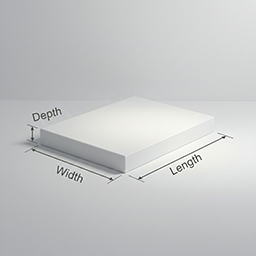
- Formula:V = L ร W ร T
where V is volume, L is length, W is width, and T is thickness (all in same units).
- Example:A 10 ft ร 10 ft slab at 4 inches thick: 10 ร 10 ร (4/12) = 33.33 cubic feet = 1.23 cubic yards
- Thickness Standards:Driveways: 4-6 inches. Patios: 4 inches. Foundations: 6-8 inches. Sidewalks: 4 inches.
Round Columns
- Formula:V = ฯ ร r2 ร H
where V is volume, r is radius (diameter รท 2), and H is height/depth.
- Example:A 12-inch diameter column, 8 feet tall: ฯ ร (0.5)ยฒ ร 8 = 6.28 cubic feet = 0.23 cubic yards
- Tip:For multiple columns, calculate one and multiply by the number of columns, then apply waste factor to the total.
Stairs
- Formula:Vstep = Ru ร Ri ร WVtotal = Vstep ร N
where V is volume, Ru is run (horizontal depth), Ri is rise (height), W is width, and N is number of steps.
- Example:5 steps, each 10" run ร 7" rise ร 36" width: (10/12) ร (7/12) ร (36/12) ร 5 = 4.86 cubic feet = 0.18 cubic yards
- Considerations:Stairs often require higher waste factors (10-15%) due to formwork complexity and tight spaces.
Curb and Gutter
- Formula:Vcurb = L ร H ร DVgutter = L ร W ร DgVtotal = Vcurb + Vgutter
where V is volume, L is length, H is curb height, D is curb depth, W is gutter width, and Dg is gutter depth.
- Example:50 ft curb: 6" height ร 6" depth = 12.5 cubic feet. Gutter: 12" width ร 4" depth = 16.67 cubic feet. Total = 29.17 cubic feet = 1.08 cubic yards
- Standard Dimensions:Residential curb: 6" height ร 6" depth. Gutter: 12" width ร 4" depth. Commercial may be larger.
Bagged vs. Ready-Mix Concrete
Bagged Concrete Calculations
- 40lb Bags:Yield: 0.011 cubic yards (0.30 cubic feet) per bag. Best for small repairs and projects under 0.5 cubic yards.
- 60lb Bags:Yield: 0.017 cubic yards (0.45 cubic feet) per bag. Good balance for medium-sized projects.
- 80lb Bags:Yield: 0.022 cubic yards (0.60 cubic feet) per bag. Most cost-effective for bagged projects, requires fewer bags.
- Calculation:Bags = total cubic yards รท yield per bag (round up). The calculator shows 40lb, 60lb, and 80lb options.
Ready-Mix Concrete Orders
- Minimum Order:Most suppliers require a minimum order of 1 cubic yard. For projects smaller than 1 yard, bagged concrete is typically more practical.
- Advantages:Consistent quality, faster placement, no mixing required, and cost-effective for projects over 1 yard.
- Ordering:Order in 0.25 or 0.5 yard increments. Always round up to the nearest increment after applying waste factor.
- Delivery Considerations:Ensure truck access, plan for continuous pour, and coordinate timing with your crew.
Weight and Transport Planning
Concrete Weight Calculations
- Weight per Cubic Yard:Wet concrete weighs approximately 4,000 pounds (1,814 kg) per cubic yard.
- Weight per Cubic Meter:Approximately 2,400 kg (5,291 lbs) per cubic meter.
- Transport Planning:Standard concrete trucks carry 8-10 cubic yards. Ensure your delivery route can handle the weight and truck size.
- Structural Support:Verify that your foundation, forms, and supports can handle the weight of wet concrete during placement.