Precision Roofing Intelligence Engine

๐Ÿ 

Roofing Calculator: Shingles, Squares & Pitch

Precision roofing estimator. Calculate roof area, squares, and bundles based on pitch, slope, and eaves. Includes material presets and wastage factors.

๐Ÿ“

Dimensions & Pitch

Vertical rise for every 12 units of run.

๐Ÿงฑ

Materials

10%
$
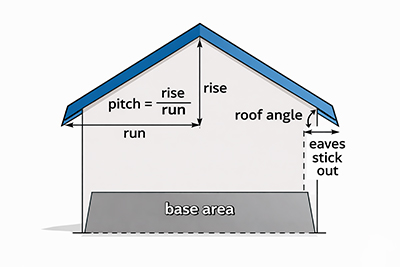
Roofing Calculator Diagram
20.40
Roofing Squares
$2,170.00
Estimated Cost
Total Calculation Area2,040 sqft
Pitch Multiplierx 1.118
๐Ÿ“ฆ
62
Bundles Needed
~33 sq ft / bundle

Roofing Calculator: Precision Estimator

Calculate the exact materials needed for your roofing project using professional pitch multipliers and eaves adjustments. Avoid under-ordering by accounting for the true geometry of your roof.

Roofing Intelligence Guide

Understanding Pitch

โ€ขPitch is the "Rise over Run".
โ€ขA 4/12 pitch means the roof rises 4 inches for every 12 inches it goes horizontally. As pitch increases, the actual roof area grows exponentially relative to the house footprint.

The Safety Threshold

โ€ขBeware the 6/12 Line.
โ€ขRoofs with a pitch greater than 6/12 are considered "steep slope" and often require toe boards or harnesses to walk on safely. This changes the project from DIY to Professional.

Material Lifespans

โ€ขNot all roofs are equal.
โ€ขAsphalt Shingles: 15-30 years. Metal: 40-70 years. Clay/Slate: 100+ years. Choose based on your climate and how long you plan to own the home.

Ventilation is Key

โ€ขDon't seal it too tight.
โ€ขEnsure you calculate for Ridge Vents and Soffit Vents. Your roof needs to "breathe" to prevent heat buildup in the attic that can bake shingles from the inside out.

Roofing Calculator: Estimate Shingles, Squares & Cost

Free roofing calculator. Convert pitch to degrees, calculate total roof area from base footprint, and estimate bundles of shingles required. Supports gable, hip, and shed roof geometries.

How to Calculate Roof Area from Ground Dimensions

The Pitch Multiplier Method

  • Step 1 (Base Area):
    Measure the length and width of the house on the ground, including the eaves overhang. Area = (Length + Overhangs) ร— (Width + Overhangs).
  • Step 2 (Find Multiplier):
    Pitch multiplier: 1+(rise/run)2\sqrt{1 + (\text{rise}/\text{run})^2}. For 6/12: โˆš[1 + (6/12)ยฒ] โ‰ˆ 1.118.
  • Step 3 (Actual Area):
    Base Area ร— Multiplier = Actual Roof Area. A 1000 sq ft footprint with a 6/12 pitch is actually 1,118 sq ft of roof.
You cannot simply use the house's length and width because the slope adds area. We use a "Pitch Multiplier" to solve this.

Common Roof Pitches

Low slope: 2/12 to 4/12. Medium slope (Walkable): 4/12 to 6/12. Steep slope (Non-walkable): 7/12 to 12/12. A-Frame: 12+/12.

FAQ

? What is a "Square" of roofing?

In the roofing industry, a Square is a unit of area equal to 100 square feet. Contractors quote prices "per square" rather than per square foot to keep numbers manageable. 10 squares = 1,000 sq ft.

? How many bundles of shingles are in a square?

For standard 3-tab or architectural asphalt shingles, there are typically 3 bundles per square. So, if you need 10 squares, you would order 30 bundles. Heavier or specialty shingles may require 4 bundles per square.

? How much extra material should I order for waste?

We recommend adding 10-15% for standard gable roofs to account for starter strips, ridges, and cutting waste. For complex roofs with many hips, valleys, or dormers, add 15-20%.

? How does roof pitch affect cost?

Steeper roofs are more expensive for two reasons: 1) The Roof Area is actually larger than the footprint (as calculated by our Pitch Multiplier), and 2) Labor costs increase significantly for pitches over 6/12 due to safety equipment requirements and slower working speeds.

? What is the "Eaves Stick Out"?

Also known as the overhang, this is the distance the roof extends beyond the exterior walls. Standard overhangs are 12-24 inches. It's crucial to include this as it adds significant square footage to the perimeter of the roof.
๐Ÿ“
DIY Estimation Note

Estimates Only: These calculators provide theoretical estimates based on standard dimensions. Material density, waste factors, and specific project conditions vary significantly.

Verify Locally: Always verify measurements and material requirements with a professional contractor or local building codes before purchasing supplies or starting work.

Project Accuracy: CalcRegistry is not responsible for material shortages, overages, or structural issues resulting from the use of these general estimates.

ยฉ 2026 CalcRegistry Reference Last Data Refresh: SEP 2025Free Online Utility Tools