Neutral density filters: the slow-shutter look, even when the sun won't cooperate
By Jeff Beem
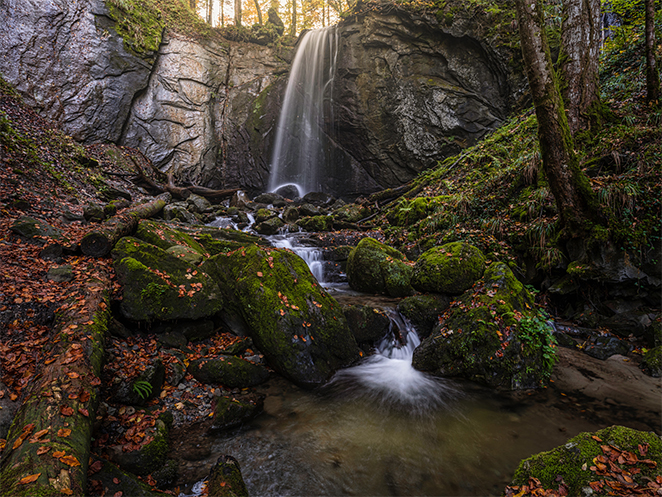
You have seen the photo: water that looks like smoke, clouds that drag across the sky, a busy plaza turned into a gentle blur of people. It almost always comes from leaving the shutter open longer. The hard part is not the idea. The hard part is that on a sunny afternoon, “longer shutter” also means “way too bright.” The histogram climbs, the highlights clip, and you are back to a fraction of a second whether you like it or not.
That is the moment neutral density filters were invented for. They are not magic. They are sunglasses for your lens, and they buy you time.
The problem in one sentence
Your camera has a bucket for light. Aperture, ISO, and shutter speed decide how fast the bucket fills. In daylight, if you open the shutter long enough to blur motion, the bucket overflows unless you dim the scene. An ND filter dims the whole frame evenly (neutral), so you can run a longer shutter without changing the look of depth of field or cranking ISO into the basement.
Stops: the language every ND label is speaking
Manufacturers love to print ND8, ND64, ND1000. Those numbers are how much light gets through, expressed as a fraction. ND64 lets through about one sixty-fourth of the light. The useful shorthand for photographers is stops: one stop is half the light (or double the time you need). ND64 lines up with 6 stops because halving six times gets you to about one sixty-fourth.
You do not have to memorize the table. What matters is the pattern:
- More stops on the filter means darker glass and longer shutter for the same exposure.
- Stacking two filters adds their stops together in the math our ND Filter Calculator uses.
The calculator spells out names like “6 stops (ND64)” next to each preset so you can match what is in your bag.
The actual math (small, I promise)
If your correct exposure without a filter uses a shutter time we will call B (in seconds), and your filter is N stops, then the new shutter time T is:
T = B × 2^N
Each stop doubles the time. Two stops means multiply by four. Six stops means multiply by sixty-four. Ten stops (think ND1000 territory) multiplies by about a thousand. That is why a crisp 1/125 s snapshot suddenly becomes a half second with six stops of ND, and why ten stops can send you into multi-second territory without touching aperture or ISO.
The tool on this site uses exactly that relationship: it takes your base shutter, adds up the stops from your stacked filters, and shows the final time, plus the nearest common camera shutter marking when that helps.
A quick example you can hold in your head
Say you meter a scene at 1/125 s, f/8, ISO 100, and it looks right. You screw on 6 stops of ND (often sold as ND64). Multiply 1/125 by 2^6 = 64. You get about 0.5 s. Same depth of field, same cleanliness, but water and movement start to show personality. If you had used 10 stops instead, you would multiply by about 1024, and 1/125 becomes roughly 8 s. At that point a tripod and a remote or timer are not accessories. They are the whole game.
What people actually shoot with ND in the real world
Waterfalls and coastlines are the classic homework assignment. A little blur reads as “soft.” Too much blur reads as fog. The “right” shutter is partly taste; the filter is what makes the choice available at noon, rather than only at blue hour.
Clouds and wind over a landscape reward the same trick. You need a long enough gap between frames in real time that the sky actually moves. ND is how you get there without waiting for a storm to darken the world.
Crowds and cities: a few seconds can melt tourists into suggestion. Ten or twenty seconds can empty a scene in a way that feels unreal. You will still need good timing and a stable tripod, but ND is what keeps the exposure sane.
The boring stuff that saves a shoot
Tripod and stability: once you are past hand-holdable territory, every vibration shows up. Center column up high in the wind is a recipe for mush.
Focus before you forget: some lenses shift focus when you drop a heavy filter stack on the front. Check after the filter is on. Manual focus and focus peaking are your friends.
Longer than thirty seconds: many cameras top out at a 30 s timed exposure. Beyond that you are in bulb mode with a remote or an app. The calculator flags when you cross that line so you are not surprised in the field.
Color and quality: very dark filters can add a color cast. Cheap ones do it more. A custom white balance or a simple correction in post is normal. Variable NDs are convenient for video; for stills, some photographers prefer fixed strengths for consistency. Use what matches your patience and your budget.
When you want the numbers without mental arithmetic
If you already know your base shutter and how many stops you are adding (one filter or a stack), plug them into the ND Filter Calculator. It is built to mirror the B × 2^N relationship above, map the result to familiar shutter markings, and let you experiment with stacks the way you would in a camera bag.
Sources
- Neutral-density filter (overview of optical density and photographic use).