How Much Protein Do You Actually Need? (Beyond the One-Number Myths)
By Jeff Beem
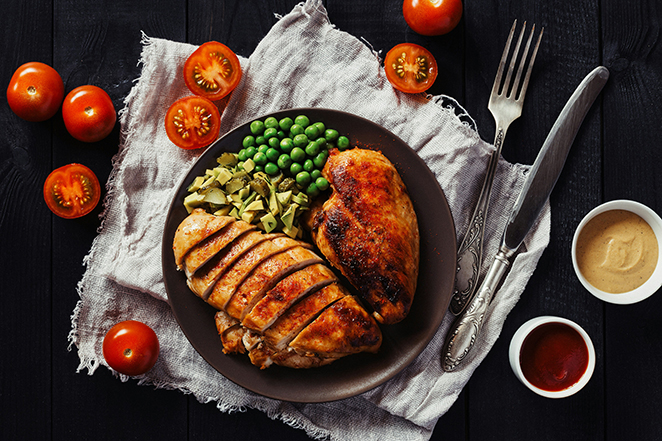
If you have ever seen “eat one gram per pound,” “stick to the RDA,” and “athletes need double,” all in the same week, you are not confused for nothing. Protein advice is noisy because the right target depends on body size, how you move, and what you are trying to do.
This guide stays grounded in how public health references usually frame protein: the RDA as a floor, higher targets per unit body weight when you train hard or want to protect muscle in a deficit, and protein as a share of total calories when you already know your daily energy budget. Science references almost always use grams per kilogram (g/kg); below you will see equivalents in pounds so you can sanity-check targets in U.S. units. It lines up with how our Protein Calculator is built: weight in pounds or kilograms, activity next, optional calories for context, pregnancy and lactation handled as add-ons, not guesswork.
This is general education, not medical nutrition therapy. If you have kidney disease, diabetes with renal complications, or a condition where protein is medically restricted, your clinician or dietitian should set the target.
The honest answer is a band, not a single meme number
“How much protein per day?” is really three questions in one:
- What is the minimum that covers basic needs for someone like me? In the U.S., that is often discussed using the Recommended Dietary Allowance (RDA) for protein, which for most adults works out to about 0.8 grams per kilogram of body weight per day (about 0.36 grams per pound of body weight, if you think in pounds). Children and teens are sometimes summarized with grams per day by age and sex instead.
- What is sensible if I lift, run hard, or work a physical job? Here, guidelines and sports nutrition references usually move the conversation to higher g/kg (grams per kilogram body weight) ranges because repair and adaptation cost amino acids. The same ideas translate to grams per pound of body weight if you prefer to think in pounds (see below).
- Does my total calorie goal change the story? When you know maintenance calories or a deficit, you can ask whether protein grams are a reasonable slice of that day, not just a grams-only score.
None of that is a secret formula. It is bookkeeping for human biology.
Why you keep seeing 0.8 g per kg (not per pound)
Yes, that is kilograms. The usual adult RDA framing in U.S. and international references is about 0.8 grams of protein per kilogram of body weight per day for many sedentary adults. It is not 0.8 grams per pound of body weight. If you multiply pounds by 0.8 and treat the result as a daily gram target, you are mixing units and you will overshoot the classic RDA ballpark by a wide margin.
A handy imperial check: 0.8 g/kg lines up with about 0.36 grams per pound of body weight per day (because one pound is smaller than one kilogram). Example: someone at 180 lb is about 82 kg; 82 × 0.8 ≈ 66 g protein, and 180 × 0.36 ≈ 65 g, the same idea in both systems.
That RDA level comes from the nutrient requirement literature summarized in the National Academies DRI report on protein and amino acids. Needs rise with pregnancy and lactation; public food-pattern guidance appears in the Dietary Guidelines for Americans. For training, the NIH Office of Dietary Supplements consumer fact sheet on exercise and athletic performance discusses why protein intake often runs higher than sedentary baselines when activity is intense.
Important nuance: the RDA is not a universal cap. Think of it as a baseline you should usually meet or exceed when your life adds training, illness recovery, or intentional weight loss.
When targets climb above the RDA floor
Activity is the big lever after body weight. In our Protein Calculator, activity maps to stepped g/kg values from roughly 0.8 (sedentary) up to about 2.0 (very intense training or a physical job plus structured training). In grams per pound of body weight, that same ladder is roughly 0.36 g/lb up to about 0.9 g/lb (multiply your weight in pounds by those factors to get a daily gram ballpark). That mirrors a common teaching pattern: start from weight, then scale upward when stress on muscle rises.
Muscle gain conversations in sports nutrition often land around roughly 1.6 to 2.2 g/kg for many adults who resistance train, assuming total calories support the goal. In pounds, that is about 0.7 to 1.0 g per lb body weight. Your exact number should follow your program, recovery, and preferences, but the directional idea is simple: training raises the protein ask.
Fat loss flips the problem. You may want more protein per kilogram than a casual maintenance diet not because muscle suddenly needs exotic fuel, but because a calorie deficit raises the risk of losing lean tissue. Many practical references cluster roughly 1.2 to 1.6 g/kg as a common planning band for adults cutting weight while trying to keep muscle, alongside strength work (about 0.55 to 0.7 g/lb body weight). It is not magic; it is insurance while the energy budget is tight.
Pregnancy and lactation add structured bumps. Many public summaries cite additional grams per day on top of a baseline pattern. The calculator follows that idea with add-ons you can toggle rather than hiding them in a footnote.
Protein as a percent of calories (why the calculator asks for them)
Dietary planning also uses Acceptable Macronutrient Distribution Ranges (AMDRs). For adults, protein is often discussed as roughly 10% to 35% of calories in U.S. intake reference materials tied to the National Academies’ macronutrient guidance. That wide band exists because people differ: an endurance athlete and a desk worker can both be healthy at different percent-protein days if grams, quality, and total energy fit their situation.
That is why entering total daily calories next to a protein goal is useful. It answers a different question: does this protein target look like a thin slice or a heavy share of my day? If you already estimated maintenance or a deficit elsewhere (for example with a TDEE Calculator or a Calorie Calculator), you can sanity-check the combination.
Putting it together without over-precision
You do not need six decimal places. A sane workflow looks like this:
- Anchor body weight in the units you actually use (kilograms or pounds).
- Pick an activity level that reflects the last few months, not the week you wish you had.
- If you are pregnant or lactating, account for that explicitly rather than folding it into “moderate activity.”
- If you track calories, plug in a maintenance or deficit number you already trust and read protein as grams and as a percent.
Then zoom out: Are the foods you tolerate and afford able to hit the range most days? A spreadsheet-perfect gram target that ignores your real kitchen is not a better plan. It is a fiction.
If you also want fat and carbohydrate targets from the same calorie line, a Macro Calculator can sit beside the protein tool. Protein is the nutrient many people under-hit when life gets busy; locking carbs and fat to preferences matters too.
Kidneys, trends, and boring safety
For healthy kidneys, higher protein intakes within common training ranges are not automatically harmful in the way old myths claimed. For existing kidney disease or certain metabolic situations, protein may need individualized limits. If that is you, treat online calculators as conversation starters with your care team, not replacements for labs and clinical judgment.
Sources
- National Academies, Dietary Reference Intakes for Energy, Carbohydrate, Fiber, Fat, Fatty Acids, Cholesterol, Protein, and Amino Acids (macronutrient ranges and protein concepts): National Academies Press
- NIH Office of Dietary Supplements, Dietary Supplements for Exercise and Athletic Performance (consumer fact sheet; includes dietary protein in the training context): ODS
- U.S. Department of Agriculture and U.S. Department of Health and Human Services, Dietary Guidelines for Americans (food pattern context for protein foods): DietaryGuidelines.gov