BMR vs TDEE for Weight Loss: How Far Below Maintenance Should You Eat?
By Jeff Beem
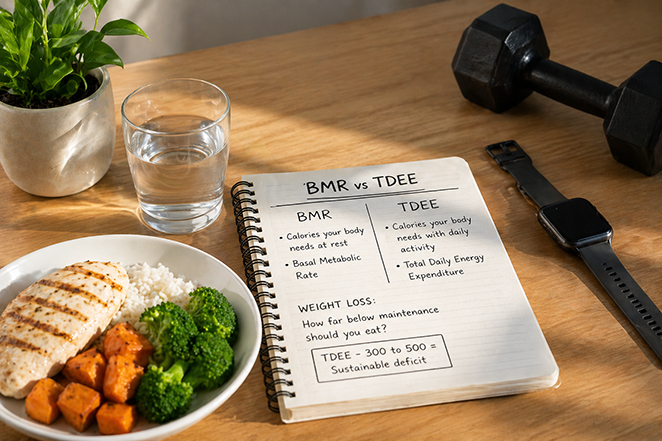
You finally pin down a maintenance calorie number, subtract 500, and the new daily target stares back looking suspiciously low. Maybe it lands a hair above your basal metabolic rate. Maybe it lands below it. The internet is full of confident voices telling you what to do next, and most of them are arguing about two numbers (BMR and TDEE) that mean different things and do different jobs.
This post is a plain-English walk through what those two figures actually represent, why a “minus 500” cut is a starting point and not a rule, and what to do when the math suggests eating fewer calories than your body uses just to keep the lights on. It mirrors how our TDEE Calculator is built: a BMR with a formula choice, an honest activity multiplier, a thermic effect of food estimate, and cutting, maintain, and bulking presets you can read against your real life.
This is general education, not medical nutrition therapy. If you have a history of disordered eating, diabetes, an active medical condition, or you are pregnant or lactating, a registered dietitian or your clinician should set the target.
Two numbers, two jobs
BMR (basal metabolic rate) is what your body would burn if you spent a full 24 hours doing essentially nothing. Lying still in a thermoneutral room, breathing, heart beating, kidneys filtering, brain humming. It is the energy bill for staying alive.
TDEE (total daily energy expenditure) is the bigger picture. It is BMR plus the calories you burn moving (walking the dog, fidgeting at your desk, training at the gym), plus the small amount your body uses digesting food (the thermic effect of food, or TEF, often estimated around 10% of intake). Outside of unusual medical situations, TDEE is always higher than BMR.
A quick concrete example. Take a 35-year-old woman, 5’5”, 150 lb, with a moderately active week. Plug those numbers into Mifflin-St Jeor and a 1.55 activity multiplier and you land roughly here:
- BMR ≈ 1,395 kcal
- Activity multiplier (Moderate, x1.55) puts TDEE around 2,160 kcal
- Inside that 2,160, roughly 1,395 is BMR, around 550 is movement, and around 215 is digestion (TEF)
Same person, sedentary week (x1.2), comes in closer to 1,675 kcal of TDEE. Same body, different calendar. That is the whole point of the multiplier: it keeps the floor (BMR) honest while letting your week do the talking.
The TDEE Calculator shows this split as a donut so you can see where the day’s calories go before it gives you a maintenance number. A dedicated BMR Calculator is useful when you only need the floor (for example, to compare against a proposed deficit, which is the next section).
Where the cutting preset comes from
The “minus 500” rule everyone repeats traces back to a rough conversion. A pound of body fat is often estimated at about 3,500 kcal of stored energy, so a daily deficit of 500 kcal across 7 days ≈ 3,500 kcal ≈ a pound a week.
Two important honest caveats live next to that rule:
- 3,500 kcal per pound is a planning approximation, not a precise constant. Real-world weight loss includes water, glycogen, and a small amount of lean tissue, especially in the first few weeks of a new deficit. The slope of the trend line is what matters, not the day-by-day match.
- The deficit that actually matters is the one you sustain. A perfect spreadsheet you abandon in three weeks loses to a slightly looser plan you run for six months.
That is why the cutting choice in the calculator is presented as a preset, not a verdict. If your TDEE comes back at 2,800 kcal, knocking it to 2,300 is a sane, sustainable starting point for many adults. If your TDEE comes back at 1,750 kcal, the same minus 500 leaves you at 1,250, and that is a different conversation, which we will get into below.
Why eating below your BMR usually backfires
A daily intake that sits below BMR for weeks is not a free fast-forward button. A few things tend to happen, usually in combination:
- Adaptive thermogenesis. When intake drops well below energy needs for an extended stretch, components of expenditure (resting metabolism, non-exercise activity, even subtle shifts in spontaneous movement) tend to drift down. The body is not a calorimeter that ignores context. Public references such as the National Academies’ DRI report on energy and the NIH Office of Dietary Supplements consumer materials describe this drift in adults during sustained energy restriction.
- Hunger and adherence. Aggressive cuts are easy on day three and hard on day thirty. Severe deficits often produce strong rebound eating, and the deficit you do not finish is the deficit that does not work.
- Sleep, training, and mood. Chronic underfeeding tends to chew at the things that make a fat-loss phase tolerable: workout quality, recovery, sleep depth, work focus, libido. None of those are vanity metrics; they are what keeps a person on the plan.
- Lean tissue. Severe deficits combined with little or no resistance training tend to give up more lean mass than moderate deficits do. The scale can keep falling while the mirror barely changes, which is rarely the outcome anyone signed up for.
For most healthy adults, the practical takeaway is simple. A moderate deficit you can hold for months beats a severe deficit you bail on in weeks. That is also why the cutting preset in the calculator is minus 500 (a moderate handle) rather than minus 1,000.
A second piece sits next to the calorie side of fat loss: protein. Targets often rise during a deficit to help protect lean tissue. If that part of the plan is fuzzy, the post on how much protein you actually need covers the bands and how to read protein as a share of total calories.
A decision flow when “TDEE minus 500” looks too low
Here is a common situation. You run the TDEE Calculator, the cutting preset lands close to (or below) your BMR, and you are not sure what to do.
A workable order of operations:
- Sanity-check the activity multiplier. Most people pick a level higher than their actual week. “Moderate” in our tool means real workouts, four to five times across the week. Office work plus a couple of weekend walks is closer to Light, sometimes even Sedentary. The honest answer is the one that mirrors the last few months, not the week you wish you had.
- Compare the cutting target against BMR. If TDEE minus 500 lands well below your BMR estimate, switch from a fixed minus 500 to a percentage-based deficit (often 10% to 20% of TDEE). For a 1,750 kcal TDEE, that is roughly 175 to 350 kcal off, landing between 1,400 and 1,575. Slower, more sustainable, and far less likely to drag you below BMR.
- Treat it as a movement question, not just a food question. Adding 4,000 to 6,000 daily steps as a real walking habit (not a one-time gym push) often raises TDEE enough that a sane deficit lives comfortably above BMR. Movement is the lever the calculator quietly rewards through the activity multiplier.
- Pick a window, not a daily verdict. Aim for a weekly average. If today is 1,500 and tomorrow is 1,800, that is not a moral failure. A two-week trend in body weight tells you whether the average is in the right zone, with far less drama.
- Reassess every two to three weeks. Adjust by 50 to 150 kcal at a time based on the trend, not on a single morning’s scale reading. Patience here is genuinely faster than impatience.
Two more notes that come up a lot:
- Maintenance is a useful preset, not just a default. People in a recomp phase (more lean mass, less body fat, similar overall weight) often eat at or near maintenance with structured training and adequate protein. The Maintain option in the calculator is doing real work, not sitting there as the polite middle button.
- Bulking is plus 300, not plus 1,000. A surplus that outruns muscle’s ability to actually grow tends to add fat. The bulking preset is conservative on purpose so the gain stays useful.
What “maintenance calories” really means in practice
A maintenance number is a band, not a single value. Within any given week, the same person can eat 1,900 one day and 2,500 the next without breaking anything, as long as the average lands near maintenance across several weeks.
That has practical consequences:
- Do not chase the daily number. Chase the trend. Two to three weeks of body weight (same conditions, ideally first thing in the morning, after the bathroom, before food) drawn on a graph or just averaged in a spreadsheet column tells you whether intake is in the right neighborhood.
- Travel weeks, holidays, and PMS retain water. A scale jump after a high-sodium dinner is not 4 lb of fat. It is water and gut contents. Trust the line, not the dot.
- Rebuild the estimate when life shifts. A new job, a new training block, an injury, a long flight, a new baby. Any of those can move TDEE enough that a number you trusted three months ago needs another pass through the calculator.
If you also want fat and carbohydrate targets sitting next to the same TDEE, a Macro Calculator reads the protein, carb, and fat splits off the same maintenance line. If your goal is more goal-oriented intake (cut, maintain, gain) without the deeper macro view, the Calorie Calculator is the close cousin.
When to step away from any online calculator
Calculators do bookkeeping. They do not do diagnosis. A few situations where the right move is to put the spreadsheet down and talk to a human:
- Eating disorder history or current disordered eating. Numbers can become unhelpful structure rather than useful structure. A clinician and a therapist are the right team.
- Medications that affect appetite, water balance, thyroid, or insulin. Dosing and disease activity can shift expenditure and weight in ways no online tool sees.
- Rapid, unexplained weight change in either direction. Get evaluated rather than chasing the number with a calculator.
- Pregnancy and lactation. Energy needs change, and so do micronutrient priorities. A registered dietitian who handles perinatal nutrition is far better than any web form.
Online TDEE estimates are starting points for healthy adults. The phrase “starting point” is the load-bearing one. The calculator gives you a defensible number to test for a few weeks; your weight trend, your training log, and how you actually feel are what say whether the test passed.
Sources
- National Academies, Dietary Reference Intakes for Energy, Carbohydrate, Fiber, Fat, Fatty Acids, Cholesterol, Protein, and Amino Acids (energy expenditure components, BMR, and equations): National Academies Press
- Mifflin MD, St Jeor ST, et al. A new predictive equation for resting energy expenditure in healthy individuals. Am J Clin Nutr. 1990;51(2):241-247: PubMed
- NIH Office of Dietary Supplements, Dietary Supplements for Exercise and Athletic Performance (energy and protein intake in the training context): ODS
- U.S. Department of Agriculture and U.S. Department of Health and Human Services, Dietary Guidelines for Americans (food pattern context, calorie levels by age and activity): DietaryGuidelines.gov