Astrophotography without star trails: the 500 rule, the NPF rule, and a practical ceiling
By Jeff Beem
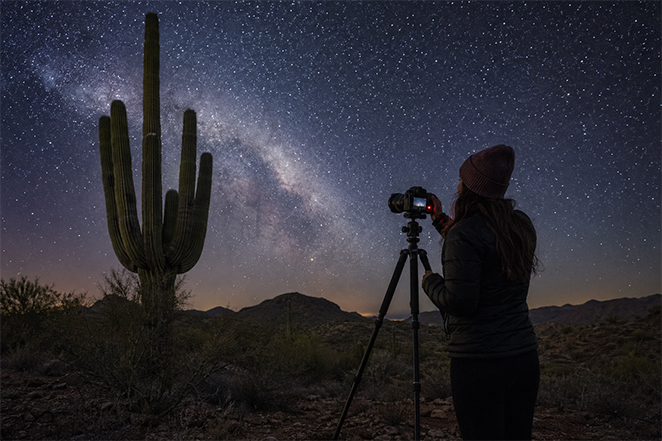
You can get everything else right, a steady tripod, a sharp lens, a dark site, a night with no haze, and still come home to photos where every star is a little dash instead of a point. That is not a moral failing. It is almost always a shutter time problem. The Earth turns. Your sensor records that motion. The only fix is a short enough exposure, a tracker that follows the sky, or a design choice to embrace trails on purpose.
This guide walks through the two rules you will see in forums and in apps: the old 500 rule and the newer NPF rule. The short version: both try to cap your longest shutter speed for untracked shots so stars stay acceptably small. NPF is pickier, especially on modern, high resolution cameras, and for many people it is the one that actually matches what they see on the screen when they zoom in.
What is actually going wrong in the frame
When people say the stars “move,” they mean the whole sky is rotating as the Earth spins. A star that sits in one part of the frame at the start of a long exposure has slid to another part of the same pixels by the end. A point source becomes a streak. A wide lens smears the motion across fewer pixels per second than a long lens, so you can usually get away with a longer shutter on a 14 mm than on an 85 mm, all else equal.
That is why focal length and how big your sensor is relative to “full frame” show up in every rule of thumb. It is not snobbery. It is geometry.
The 500 rule: quick, rough, and showing its age
The 500 rule is a simple fraction:
Maximum time (seconds) is about 500 divided by (focal length × crop factor).
Focal length is the number on your lens in millimetres. Crop factor is how you translate your sensor to a full frame reference: about 0.8× for many 44×33 mm medium format bodies (a larger sensor than “full frame,” so the factor is below 1), 1.5× for many APS C bodies, 2× for Micro Four Thirds, and 1× for full frame. For a 24 mm lens on full frame, 500 ÷ 24 is a bit over 20 seconds. On APS C with the same lens field of view (say 16 mm), you use 16 in the denominator instead of 24, so the time goes up for the “same” composition.
This rule is easy to remember in the field. It also comes from an era when roll film and modest prints hid a little blur. On high resolution digital files, 500 is often too generous. You can follow it and still see small trails when you view at 100 percent. It is still useful as a ceiling in your head when you are deciding whether you are in the “single digit seconds” or “20 second” mood.
Why “more megapixels” made simple rules wobble
A modern sensor is a grid of tiny light buckets. Pixel pitch is the size of one of those buckets, often written in micrometres (µm). Smaller pitch means you packed more resolution into the same area. You get more detail, but star movement crosses a small pixel in less time than a big one. The 500 rule does not “see” pixel size at all. A 45 MP body and a 12 MP body get the same 500 result for the same lens and crop, which is a hint that 500 is not the end of the story if you are picky about corners and prints.
The NPF rule: a stricter, camera aware limit
The NPF rule (you will also see it called the “pixel rule” in some threads) bakes in aperture, pixel pitch, and declination, so the answer can tighten when your gear and target ask for it. In plain language:
- A wider aperture (a lower f number) and smaller pixels both nudge the allowed time down in the way this rule is used on our Astrophotography Calculator. That matches intuition: a wide aperture lets you finish the exposure with less time at a given ISO, and small pixels do not forgive motion as well.
- Declination is the sky version of latitude. At 0° (near the celestial equator), objects appear to scoot across the frame the fastest. Near the celestial poles (up toward ±90°), the motion in the frame slows. So the same camera can sometimes safely use a longer shutter when you are pointed at a high declination object than when you are on the equator, if everything else is equal.
You will also see a pixel tolerance factor, often written k, in NPF style calculators. Think of k as how strict you are about the word “round.” k near 1.0 is the fussy, print and crop friendly setting. A slightly higher k loosens the cap so you can run a longer exposure, gather a bit more light, and keep ISO down, in exchange for stars that are not perfect points when you pixel peep. That trade is personal. A social feed at web resolution forgives more than a wall print.
How the two rules are usually combined in practice
Most photographers who want the cleanest result take the shorter of the 500 answer and the NPF answer. In other words, the tighter limit wins. On many current cameras, that means NPF is the one doing the work for pinpoint stars, and 500 is a sanity check, not a license to go long.
You do not have to be precious every night. A little softness at the pixel level might be fine if the Milky Way still reads well and the noise is under control. The important part is to know which number is which so you are not surprised at the computer.
In the field: a workflow that does not fight you
A few habits help more than a perfect formula. Once you are past a second or two, use a real tripod and a cable release or timer. Touching the camera to start a 15 second frame is a great way to get mush.
Focus with intent: live view, magnification, a bright star. If your lens has a hard infinity stop, trust but verify. Temperature changes the length of the barrel more than we like to admit.
Before you treat the NPF number as gospel, know where you are pointed. A planetarium app, a paper atlas, or a phone ephemeris will give you declination. The core of the Milky Way in many compositions sits in a part of the sky where declination is low; that is exactly where the math is rough on long exposures, so you do not want to guess.
Dim your screen when you check numbers. The calculator on this site has a red light mode and a one line summary you can copy. That is not a gimmick. Bright white light at 2 a.m. wrecks your night vision. Red UI keeps you a little more human in the moment.
If the Moon is in play or you are blending twilight, you are back to exposure triangle thinking. Our ND Filter Calculator is the sibling tool for taming light when the sky is not fully dark.
How this pairs with the rest of your night kit
If you are new to the vocabulary of sensor sizes and equivalent focal length, the Crop Factor Calculator and our article on sensor size and crop factor connect the same ideas from daylight photography to the night version.
If you are stacking many short untracked frames, or you are about to learn interval timing for motion in the frame, the Time-lapse Planning Calculator lines up with the time-lapse guide on this site. Exposure length and interval are different knobs, but they have to fit the same night.
When a calculator beats mental arithmetic
You can do this in your head, and you should be able to ballpark. When you are tired, cold, and deciding between ISO 3200 and 6400, a tool that shows both 500 and NPF, with your real focal length, crop, and declination, keeps mistakes off the card.
Open the Astrophotography Calculator, set your focal length and f stop, pick a sensor preset (or use Custom with crop and pixel pitch from your spec sheet, or sensor width and horizontal resolution to derive pitch). Add declination for the patch of sky you care about, adjust pixel tolerance (k) if you want a stricter or looser star, and read the maximum recommended time. Flip red light mode on site, copy the settings summary for your notes if you like, and get back to shooting.
Sources
- Wikipedia, Star trail (Earth’s rotation, long exposure, and how apparent motion of stars shows up in a frame).
- Photography Life, 500 Rule vs NPF Rule: Shutter Speed for Astrophotography (side by side look at the two rules in practice, including the trade between star sharpness, focal length, and noise). For the exact form implemented on CalcRegistry (including declination in the NPF style denominator and pixel tolerance k), see the How the Math Works section on the Astrophotography Calculator page.
Astrophotography is weather, gear, and patience. The math just keeps the stars where you want them: round enough for the story you are trying to tell.