๐Ÿ”Œ

Ohms Law Calculator

Calculate Voltage, Current, or Resistance.

๐Ÿ”Œ

Circuit Parameters

Enter any two values; the other two are calculated automatically. Use the unit dropdowns for SI prefixes.

Results

Enter any two values

Voltage, Current, Resistance, or Power. The remaining two will be calculated.

๐Ÿ”Œ

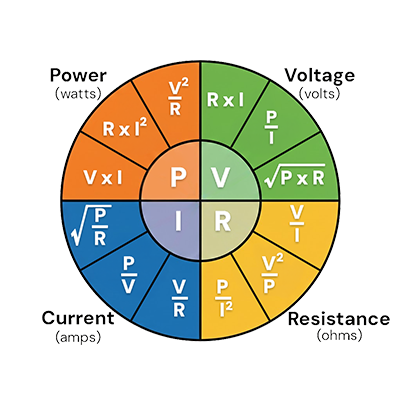
Ohm's Law Wheel

Ohm's Law Wheel showing formulas for Voltage, Current, Resistance, and Power: V = Rร—I, P/I, โˆš(Pร—R); I = V/R, P/V, โˆš(P/R); R = V/I, Vยฒ/P, P/Iยฒ; P = Vยฒ/R, Rร—Iยฒ, Vร—I

Ohm's Law Masterclass

What Is Ohm's Law & Its History

In 1827, Georg Ohm published the relationship after years of experiments with metal wires and voltaic cells. He found current through a conductor scaled with the potential difference across it and inversely with a property he named resistance. Critics at the time dismissed it; it's now the backbone of circuit design.

The "Physics of Pressure" analogy fits well: voltage is electrical pressure, resistance is friction, and current is flow. Higher voltage pushes more charge; higher resistance chokes it. That mental model helps when sizing resistors or troubleshooting circuits.

The Variable Breakdown

Voltage (V)
Electromotive forceโ€”the push that drives charge. Units: volts. In the formula , it's the "pressure" that sets current for a given resistance.
Current (I)
Charge flow rate through a conductor. Units: amperes. One amp is one coulomb per second passing a point. Higher current means more electrons moving.
Resistance (R)
Opposition to current. Units: ohms (ฮฉ). Wires, resistors, and loads all contribute. Thinner or longer wires raise R; copper beats steel for the same gauge.
Power (P)
Rate of energy conversion to heat, light, or motion. Units: watts. , or and when resistance is known.

Real-World Applications

  • LED Resistor Sizing

    Typical LED: ~20 mA at 2 V. From 5 V: R = (5 โˆ’ 2) / 0.02 = 150 ฮฉ. Round up to the nearest standard value (150 or 220 ฮฉ) to avoid frying the LED.

  • Home Appliance Amperage

    1,200 W microwave on 120 V: I = 1200 / 120 = 10 A. Most circuits top out at 15โ€“20 A. Stack too many high-wattage devices and you'll trip the breaker.

  • Car Battery Diagnostics

    A good 12 V battery has low internal resistance and delivers strong current to the starter. If voltage drops under load, internal R has climbedโ€”often from age or sulfation.

  • Fuse and Breaker Sizing

    Fuses protect wiring by limiting current. A short (R โ‰ˆ 0) sends current through the roof. Pick a fuse that opens before the wire overheatsโ€”Ohm's Law defines that boundary.

Ohmic vs Non-Ohmic & Temperature

The law holds for Ohmic materialsโ€”resistance stays flat over voltage and current. Metals, carbon resistors, and most wires qualify. Diodes, LEDs, and filaments are non-Ohmic: their R shifts with V and I, so V = IR breaks down.

Temperature matters. Copper gains ~0.4% resistance per ยฐC. A 25ยฐC rise adds ~10% to Rโ€”enough to throw off precision work or high-power designs. NTC thermistors drop resistance as they heat; we use them for sensing and inrush limiting.

Ohm's Law Quick Reference

Enter any two of V, I, R, or P and the calculator solves the rest. For deeper theoryโ€”Georg Ohm's history, variable meanings, real-world examples, and Ohmic vs non-Ohmicโ€”see the Masterclass below.

Formula Cheat Sheet

Voltage

V=Iร—RV = I \times R, V=P/IV = P / I, V=Pโ‹…RV = \sqrt{P \cdot R}

Current

I=V/RI = V / R, I=P/VI = P / V, I=P/RI = \sqrt{P / R}

Resistance

R=V/IR = V / I, R=V2/PR = V^2 / P, R=P/I2R = P / I^2

Power

P=Vร—IP = V \times I, P=I2RP = I^2 R, P=V2/RP = V^2 / R

Ohm's Law Calculator: Voltage, Current, Resistance & Power

Calculate V, I, R, and P from any two values. SI unit support, formula wheel, and step-by-step work. For students, hobbyists, and pros.

How to Use the Ohm's Law Calculator

Pick any two of voltage, current, resistance, or power and enter them. The calculator finds the other two. Choose unit prefixes (V, kV, mV; A, mA, ยตA; ฮฉ, kฮฉ, Mฮฉ; W, kW, mW) to match your circuit. All 12 formula variants are handled: V=Iร—RV = I \times R, P=Vร—IP = V \times I, R=V2/PR = V^2 / P, and the rest.

Ohm's Law Formula and the Power Equation

V=Iร—RV = I \times R is Ohm's Law. Power (watts) is P=Vร—IP = V \times I. Substituting V = IR gives P=I2RP = I^2 R; substituting I = V/R gives P=V2/RP = V^2 / R. These fourโ€”V, I, R, Pโ€”let you solve for any one from the other three. The calculator shows the exact formula used and the numeric steps.

LED Resistor Calculator and Other Common Uses

LED current limiting: if your LED needs 20 mA at 2 V and you have 5 V, R = (5 โˆ’ 2) / 0.02 = 150 ฮฉ. Appliance amperage: a 1,200 W device on 120 V draws 10 A. Car battery health: voltage sag under load suggests rising internal resistance. The calculator handles these without extra tools.

FAQ

What is Ohm's Law?

Ohm's Law links voltage (V), current (I), and resistance (R): V = I ร— R. It's the starting point for DC circuit analysisโ€”size resistors, check loads, and troubleshoot circuits.

How do I calculate power from voltage and current?

Power in watts is voltage times current: P = V ร— I. When you know resistance, use P = Iยฒ ร— R or P = Vยฒ / R instead.

What units does Ohm's Law use?

Volts (V), amperes (A), ohms (ฮฉ), and watts (W). The calculator supports SI prefixes: kV, mV, mA, ยตA, kฮฉ, Mฮฉ, kW, mW.

Does Ohm's Law work for AC circuits?

For resistive loads, yesโ€”use RMS voltage and current. Inductors and capacitors need impedance (Z), not resistance.

When does Ohm's Law not apply?

Non-Ohmic devices like diodes and LEDs change resistance with voltage. For those, use the law only on the resistive parts (e.g., the series resistor).
โšก

Electronics Reference Note

Educational Use: These tools use standard electrical formulas (e.g., Ohm's Law, NEC voltage drop) for learning, hobby projects, and general referenceโ€”not for licensed electrical work or safety-critical installations.

Verification Recommended: Wire sizing, voltage drop, and circuit design depend on local codes, ambient conditions, and load profiles. For real installations, consult a qualified electrician or engineer.

Not Professional Advice: This site does not provide electrical or engineering advice. All calculations run locally in your browser; no data is stored or transmitted.

ยฉ 2026 CalcRegistry Reference Last Logic Update: April 2026Free Online Utility Tools